
In collective and class action wage and hour cases, one of the most critical and contentious stages is discovery—particularly when it comes to determining the size and composition of the discovery class. Defense attorneys often seek to impose unreasonable demands, such as requiring depositions from a large number of opt-in plaintiffs, or they propose selection methods that introduce bias, such as “you pick some; I pick some.” These strategies can burden plaintiffs’ counsel with unnecessary costs, delay proceedings, and undermine the fairness of the discovery process.
However, there is a better, mathematically rigorous way to ensure a fair and efficient discovery process: the use of the binomial distribution to justify a statistically valid discovery class.
The Problem with Non-Random Selection
When defense attorneys propose a “you pick some; I pick some” approach to selecting discovery class members, the result is often a skewed sample that fails to represent the larger population of opt-in plaintiffs. This method introduces bias—intentional or not—and undermines the entire purpose of representative discovery. For example, defense counsel might select individuals whose claims are weaker, or who are less likely to testify consistently with the rest of the class. This tactic distorts the sample and makes it impossible to draw reliable conclusions about the broader population.
To illustrate the danger of non-random selection, consider a bag of 100 marbles, where 98 are red, and 2 are yellow. If either side can intentionally select the marbles, it is easy to pick the 2 yellow marbles and claim that the entire bag is yellow. This is why randomness in selection is not just a preference—it is a necessity to ensure fairness.
The Binomial Distribution: A Tool for Advocating Reasonable Discovery
The binomial distribution provides a mathematically sound framework to argue for a discovery class that is both reasonable in size and representative of the opt-in population. By leveraging this tool, plaintiffs’ counsel can push back against excessive discovery demands and biased selection methods.
Here’s how the binomial distribution can be applied:
- Randomness Ensures Representation: To draw valid conclusions about the entire opt-in population, it is essential to select discovery class members randomly. This eliminates bias and ensures that the sample accurately reflects the population.
- Mathematically Determining Class Size: A discovery class of 20 individuals, selected randomly, is often sufficient to provide statistically valid evidence. Using the binomial distribution, plaintiffs’ counsel can show that this sample size is appropriate for determining both liability and whether the class is similarly situated for purposes of a collective trial.
- Probabilistic Proof: In wage and hour cases, plaintiffs often need to prove that their claims and those of the opt-in plaintiffs are more likely than not (i.e., greater than 50%). The binomial distribution provides a rigorous method to calculate the probability that the population’s claims are consistent with those observed in the sample.
Example: Applying the Binomial Distribution
Suppose plaintiffs argue that 70% or more of the population must have experienced the same violation of wage and hour laws to justify a collective trial. After discovery, 14 out of 20 randomly selected discovery class members confirm experiencing the same violation. Using the binomial distribution, we can calculate the probability that 70% or more of the entire population would claim the same violation:
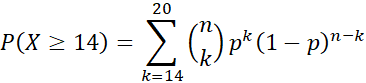
Where:
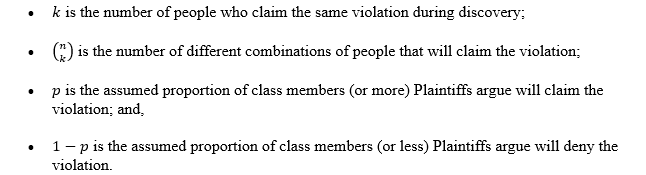
In this scenario, the calculation shows a 60.8% probability that 70% or more of the population will claim the violation, making it more likely than not. This satisfies the burden of proof and supports plaintiffs’ argument for proceeding collectively.
Countering Defense Strategies
- Excessive Discovery Requests: Defense attorneys often demand depositions from an unreasonably high number of opt-in plaintiffs, knowing it will exhaust plaintiffs’ resources. Plaintiffs’ counsel can use the binomial distribution to argue that a smaller, random sample is sufficient to provide reliable evidence, avoiding unnecessary delays and costs.
- Biased Selection Methods: When defense attorneys propose non-random selection methods, plaintiffs’ counsel should emphasize that randomness is the only way to ensure a representative sample. Highlighting the mathematical rigor of the binomial distribution strengthens the argument that any non-random selection method is inherently flawed.
The Takeaway
Using the binomial distribution to advocate for a reasonable discovery class is a powerful strategy for wage and hour litigation firms. By focusing on randomness and leveraging well-established statistical methods, plaintiffs’ counsel can push back against defense tactics that aim to distort the discovery process and burden plaintiffs. A discovery class of 20 randomly selected individuals is not only fair but also scientifically valid, ensuring that the discovery process serves its intended purpose: determining the truth about the population as a whole.
At Lex Triage, we’re committed to helping law firms harness the power of STEM to improve litigation outcomes. Contact us to learn more about how our tools and insights can support your practice in advocating for fairness and efficiency in discovery.
Connect with us
