
Using the Binomial Distribution to Advocate for a Reasonable Discovery Class in Wage and Hour Litigation
In collective and class action wage and hour cases, one of the most critical and contentious stages is discovery—particularly when it comes to determining the size and composition of the discovery class. Defense attorneys often seek to impose unreasonable demands, such as requiring depositions from a large number of opt-in plaintiffs, or they propose selection methods that introduce bias, such as “you pick some; I pick some.” These strategies can burden plaintiffs’ counsel with unnecessary costs, delay proceedings, and undermine the fairness of the discovery process.
However, there is a better, mathematically rigorous way to ensure a fair and efficient discovery process: the use of the binomial distribution to justify a statistically valid discovery class.
The Problem with Non-Random Selection
When defense attorneys propose a “you pick some; I pick some” approach to selecting discovery class members, the result is often a skewed sample that fails to represent the larger population of opt-in plaintiffs. This method introduces bias—intentional or not—and undermines the entire purpose of representative discovery. For example, defense counsel might select individuals whose claims are weaker, or who are less likely to testify consistently with the rest of the class. This tactic distorts the sample and makes it impossible to draw reliable conclusions about the broader population.
To illustrate the danger of non-random selection, consider a bag of 100 marbles, where 98 are red, and 2 are yellow. If either side can intentionally select the marbles, it is easy to pick the 2 yellow marbles and claim that the entire bag is yellow. This is why randomness in selection is not just a preference—it is a necessity to ensure fairness.
The Binomial Distribution: A Tool for Advocating Reasonable Discovery
The binomial distribution provides a mathematically sound framework to argue for a discovery class that is both reasonable in size and representative of the opt-in population. By leveraging this tool, plaintiffs’ counsel can push back against excessive discovery demands and biased selection methods.
Here’s how the binomial distribution can be applied:
- Randomness Ensures Representation: To draw valid conclusions about the entire opt-in population, it is essential to select discovery class members randomly. This eliminates bias and ensures that the sample accurately reflects the population.
- Mathematically Determining Class Size: A discovery class of 20 individuals, selected randomly, is often sufficient to provide statistically valid evidence. Using the binomial distribution, plaintiffs’ counsel can show that this sample size is appropriate for determining both liability and whether the class is similarly situated for purposes of a collective trial.
- Probabilistic Proof: In wage and hour cases, plaintiffs often need to prove that their claims and those of the opt-in plaintiffs are more likely than not (i.e., greater than 50%). The binomial distribution provides a rigorous method to calculate the probability that the population’s claims are consistent with those observed in the sample.
Example: Applying the Binomial Distribution
Suppose plaintiffs argue that 70% or more of the population must have experienced the same violation of wage and hour laws to justify a collective trial. After discovery, 14 out of 20 randomly selected discovery class members confirm experiencing the same violation. Using the binomial distribution, we can calculate the probability that 70% or more of the entire population would claim the same violation:
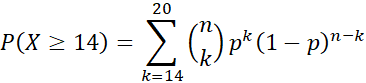
Where:
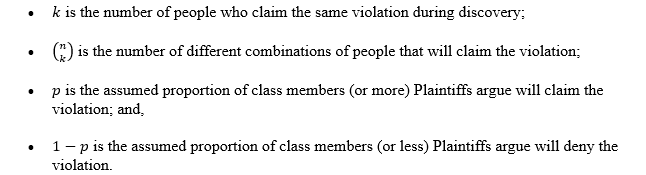
In this scenario, the calculation shows a 60.8% probability that 70% or more of the population will claim the violation, making it more likely than not. This satisfies the burden of proof and supports plaintiffs’ argument for proceeding collectively.
Countering Defense Strategies
- Excessive Discovery Requests: Defense attorneys often demand depositions from an unreasonably high number of opt-in plaintiffs, knowing it will exhaust plaintiffs’ resources. Plaintiffs’ counsel can use the binomial distribution to argue that a smaller, random sample is sufficient to provide reliable evidence, avoiding unnecessary delays and costs.
- Biased Selection Methods: When defense attorneys propose non-random selection methods, plaintiffs’ counsel should emphasize that randomness is the only way to ensure a representative sample. Highlighting the mathematical rigor of the binomial distribution strengthens the argument that any non-random selection method is inherently flawed.
The Takeaway
Using the binomial distribution to advocate for a reasonable discovery class is a powerful strategy for wage and hour litigation firms. By focusing on randomness and leveraging well-established statistical methods, plaintiffs’ counsel can push back against defense tactics that aim to distort the discovery process and burden plaintiffs. A discovery class of 20 randomly selected individuals is not only fair but also scientifically valid, ensuring that the discovery process serves its intended purpose: determining the truth about the population as a whole.
At Lex Triage, we’re committed to helping law firms harness the power of STEM to improve litigation outcomes. Contact us to learn more about how our tools and insights can support your practice in advocating for fairness and efficiency in discovery.
Provisional Patent Secured for AI-Powered Legal Document Automation and Predictive Analytics
A provisional patent has been secured by Lex Triage founder and CEO, Hans Nilges, and computer scientist James Spinella for an AI-driven system designed to automate legal document processing and enable predictive analytics in litigation. This patent covers a multi-phase AI system that extracts, organizes, and analyzes legal case data to improve litigation workflows, enhance efficiency, and support data-driven decision-making.
Lex Triage is currently developing this system to support automated legal document drafting, focusing first on wage and hour and employment complaints, declarations, and discovery requests. This foundational work will enable the predictive analytics phase, which will introduce case valuation, motion-level predictions, and other litigation forecasting tools.
What This Patent Covers
The patent describes an AI-powered system that extracts and processes legal documents to support automated drafting, litigation strategy, and predictive modeling.
Key Innovations
✅ AI-Powered Legal Document Processing – The system extracts, processes, and organizes legal documents and court filings using AI. It classifies and structures key legal data elements to facilitate automated drafting of case-related documents such as wage and hour and employment complaints, declarations, and discovery requests.
✅ Transforming Unstructured Legal Text into Structured Data – The system extracts meaningful legal and procedural insights from raw, unstructured text in court filings, motions, and rulings. It identifies patterns in judicial rulings, defense strategies, settlement structures, and the scope of wage and hour violations, converting them into a structured, searchable dataset. This enables automated document drafting and advanced litigation analytics.
✅ Data Processing and Storage for Legal Analytics – Extracted case data is processed through a structured pipeline that cleans, organizes, and stores the information in a legal data warehouse. This system enables efficient retrieval and application of structured legal data for downstream tasks, such as document drafting and analytics.
✅ AI-Driven Categorization of Legal Documents – The system classifies legal documents based on keyword and phrase recognition using machine learning and natural language processing (NLP) techniques. This categorization ensures that relevant legal information is accurately identified and processed for use in litigation strategies.
✅ Predictive Modeling for Case and Motion-Level Outcomes (Future Phase) – The system leverages boosted tree algorithms and statistical modeling to analyze structured case data and assess litigation risks. These models will be used to estimate case values, predict motion success rates, and evaluate claim viability based on historical case trends.
Rather than replacing legal expertise, the system enhances efficiency, reduces manual work, and improves the ability to extract meaningful insights from litigation data.
Phase 1: AI-Driven Legal Document Drafting
Lex Triage is actively developing and training its AI system to streamline the processing of wage and hour and employment complaints, declarations, and discovery requests.
🔹 Complaint Drafting – Training AI models to generate case-specific complaints using structured case metadata.
🔹 Declaration Generation – Developing AI-assisted drafting for affidavits and declarations.
🔹 Discovery Assistance – Automating interrogatories and requests for production, streamlining case preparation.
Once the AI-powered legal document processing system is validated and optimized, Lex Triage will shift focus to Phase 2: Predictive Analytics.
Phase 2: Predictive Analytics Development
After refining its document automation capabilities, Lex Triage will develop predictive analytics models based on structured legal data. This phase will introduce:
🔹 Expected Value (EV) Calculations – Providing attorneys with data-backed assessments of case worth and settlement risks.
🔹 Motion-Level Predictions – Using historical case data to evaluate the likelihood of success for specific motions.
🔹 Judicial Pattern Analysis – Identifying decision trends among judges, helping attorneys refine their litigation strategies.
How Predictive Analytics Will Work
- The system will apply boosted tree algorithms, among other advanced data-science tools, and statistical modeling to structured case data.
- Legal metadata, including settlement amounts, claim classifications, and motion outcomes, will be processed to provide case-specific predictions.
- Attorneys will be able to assess risk levels and case viability using AI-driven analytics rather than relying solely on experience or intuition.
This transition from document automation to litigation forecasting is a natural evolution of Lex Triage’s AI-driven legal strategy.
A Step Toward AI-Driven Litigation Strategy
This provisional patent marks a major milestone in Lex Triage’s broader mission to integrate STEM principles into legal decision-making.
With AI-powered legal document processing in development and predictive analytics as the next phase, Lex Triage is moving toward a future where litigation strategy is backed by structured, data-driven insights.
Stay tuned for updates as we continue developing these AI-driven legal solutions.
Using Formal Logic to Analyze Court Decisions: Distinguishing Universal and Particular Rules
Introduction
Legal analysis often requires determining whether a court decision establishes a universal principle that applies to all similar cases or a particular rule that applies only to a limited set of circumstances. When courts use broad language, it can be unclear whether the ruling governs future cases that differ slightly in fact but may share essential characteristics.
One of the most effective ways to analyze this is through formal logic, particularly categorical syllogisms. By structuring judicial reasoning into logical form, we can evaluate whether a decision supports a legal argument, contradicts it, or is simply inapplicable. This article provides a method for analyzing court decisions using formal logic, demonstrating how to determine if a precedent extends to new fact patterns. We will first apply this approach to a hypothetical case and then validate the analysis with a real-world example: Gorman v. Consolidated Edison Corp.
Consider the following scenario:
A court rules that workers in a widget manufacturing plant are not entitled to compensation for the time spent donning and doffing standard protective gear such as gloves, safety glasses, and work uniforms because such gear is commonly worn in many workplaces and does not uniquely protect against significant workplace hazards. The court holds that only gear that is integral and indispensable to the work being performed qualifies for compensation.
From a formal logic perspective, this ruling can be structured as a categorical syllogism:
- Major Premise (Legal Principle Established by the Court): Only activities that are integral and indispensable to an employee’s principal work activities—such as those necessary to protect against special harm—are compensable under wage laws.
- Minor Premise (Application to the Hypothetical Case): The protective gear at issue (gloves, glasses, and work uniforms) is not necessary to protect against special harm.
- Conclusion: Therefore, time spent donning and doffing this protective gear is not compensable.
This ruling could be either a universal rule or a particular one depending on how the major premise is interpreted. This distinction is key when applying the case to new scenarios, such as food manufacturing or cleanroom industries, where protective gear serves a different function.
Testing the Rule’s Scope in New Situations
Suppose another case arises where employees working in a food manufacturing facility argue that time spent donning sanitary gear (gowns, masks, gloves) should be compensable. Unlike the widget factory case, this gear is not primarily for the worker’s protection—it is designed to prevent contamination of food products. Similarly, in a cleanroom manufacturing environment, protective suits and gloves prevent damage to sensitive products or equipment in microchip fabrication or pharmaceutical manufacturing.
To determine whether the original ruling applies, we must ask: Was the major premise universal or particular?
Scenario 1: The Ruling Was Universal (Applies to All Special Harm Cases, Not Just Worker Safety)
If the original decision was meant to apply broadly to all cases involving donning and doffing protective gear, then it must encompass all forms of special harm, including harm to others (e.g., contamination risks in food processing or damage to cleanroom products).
Logical application:
- Major Premise (Universal Interpretation): Only donning and doffing protective gear that prevents any form of special harm (to workers, the public, or products) is compensable.
- Minor Premise (Food/Cleanroom Gear Application): Sanitary and cleanroom gear prevents special harm by protecting food products, manufactured items, and public health.
- Conclusion: Therefore, time spent donning and doffing sanitary or cleanroom gear is compensable.
If the decision was meant to be universal, it would actually require compensating workers who don sanitary or cleanroom gear, since preventing contamination or product damage constitutes protection against special harm.
Scenario 2: The Ruling Was Particular (Limited to Worker Protection Cases)
If the original ruling only applied to cases where the gear was meant to protect the worker, then it does not necessarily govern food or cleanroom gear cases. In this case, a new syllogism is required for those contexts.
Logical application:
- Major Premise (Particular Interpretation): Only donning and doffing protective gear that prevents special harm to the worker is covered by the prior ruling.
- Minor Premise (Food/Cleanroom Gear Application): Sanitary and cleanroom gear does not protect the worker but protects others or the product.
- Conclusion: Therefore, the prior ruling does not apply to sanitary or cleanroom gear cases.
Here, the predicate term in the major premise is undistributed, meaning it does not apply to all types of protective gear—only to worker-protective gear. Since sanitary and cleanroom gear is designed to protect third parties or the integrity of the product being manufactured, it falls outside the original ruling’s scope.
Validating the Analysis with a Real Case
The reasoning above can be tested against an actual case: Gorman v. Consolidated Edison Corp. In Gorman, the Second Circuit ruled that donning and doffing helmets, safety glasses, and steel-toed boots was not compensable because it was not integral and indispensable to the employees’ principal work activities.
If Gorman’s major premise was universal—covering all special harm cases—then sanitary and cleanroom gear must be compensable because it protects against special harm (contamination or damage to manufactured products).
If Gorman’s major premise was particular—only addressing worker-protective gear—then it does not control cases involving sanitary or cleanroom gear, meaning those cases must be analyzed separately.
Either way, using formal logic clarifies whether Gorman can be cited as precedent in future cases or whether it must be distinguished.
Conclusion: Why Formal Logic Matters in Legal Analysis
Court decisions often leave room for interpretation. By using formal logic, attorneys can:
- Determine whether a ruling establishes a universal or particular principle.
- Assess whether a case supports or contradicts their argument.
- Clarify judicial reasoning and expose logical gaps.
This approach applies broadly across many areas of employment law, including wage and hour disputes, workplace safety compliance, and regulatory interpretation. The Gorman case serves as just one example of how formal logic can be applied to legal analysis, helping attorneys make more precise arguments and anticipate judicial reasoning.
—
Lex Triage helps employment and wage attorneys apply data-driven, logical approaches to litigation and compliance. Contact us to learn how we can enhance your legal strategy.
Connect with us
